
What Is Website Design and Development? A Simple Guide for Beginners
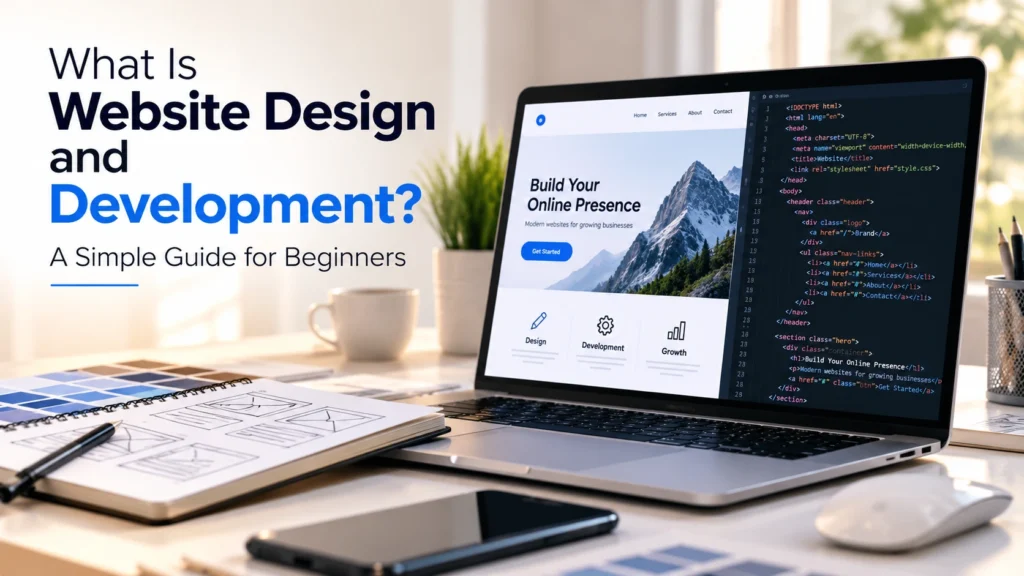
A website is often the first place people go when they want to learn about a business, service, product, or organization. But creating a good website involves more than choosing a nice design and adding some text.
Website design and development are two important parts of creating a website. Design focuses on how a website looks and how people use it. Development focuses on how the website works behind the scenes.
Together, they turn an idea into a working website that people can visit, use, and interact with.
In this guide, we will explain what website design and development mean, how they are different, how they work together, and what you should consider when creating a website for your business.
What Is Website Design?
Website design is the process of planning and creating the visual appearance and user experience of a website.
It includes things such as:
- Page layout
- Colours
- Fonts
- Images
- Buttons
- Menus
- Spacing
- Website structure
- Mobile appearance
- User experience
The goal of web design is not only to make a website look attractive. A good design should also make it easy for visitors to find information and take action.
For example, a service business may need visitors to quickly find its services, contact details, location, and enquiry form. A well-planned design can make these things easy to find.
What Does a Web Designer Do?
A web designer plans how the website will look and how visitors will move through it.
Depending on the project, a designer may work on:
- Homepage design
- Service pages
- Navigation menus
- Contact forms
- Calls to action
- Images and graphics
- Responsive layouts
- User interface elements
- Overall visual consistency
A designer also needs to think about different screen sizes. A website that looks good on a desktop should also work properly on smartphones and tablets.
What Is Website Development?
Website development is the process of building the functional parts of a website.
Development takes the planned design and turns it into a working website.
It can involve:
- Front-end development
- Back-end development
- Database connections
- Website functionality
- Forms and integrations
- Content management systems
- Security
- Performance improvements
- Website maintenance
For example, when you click a button, submit a form, create an account, or use an online shopping cart, development makes those functions work.
What Does a Web Developer Do?
A web developer builds and maintains the technical side of a website.
The work can range from creating simple business websites to developing complex web applications.
A developer may work with technologies such as:
- HTML
- CSS
- JavaScript
- PHP
- Databases
- Content management systems
- APIs
- E-commerce platforms
The exact technologies depend on the type and requirements of the website.
Website Design vs Website Development
The main difference is simple:
Website design focuses on how a website looks and how users interact with it, while website development focuses on how the website functions.
Think of building a house.
The design is like the architectural plan. It decides how the house should look, where rooms should be placed, and how people will use the space.
Development is like the construction process. It turns that plan into something that actually works.
Both parts are important. A beautiful website with poor functionality can frustrate visitors. A technically strong website with a confusing design can also make it difficult for people to use.
How Do Website Design and Development Work Together?
Design and development usually happen as connected steps rather than completely separate processes.
A typical website project may follow this process:
1. Understand the Business
The first step is to understand the business, its audience, goals, services, and competitors.
For example, a local dental clinic may need a website that helps potential patients learn about treatments and book an appointment.
An online store may have different requirements, such as product pages, payments, shipping, and customer accounts.
2. Plan the Website Structure
Next, the pages and navigation are planned.
A basic business website may include:
- Home
- About
- Services
- Individual service pages
- Locations
- Blog
- Contact
The structure can be different for every business.
3. Create the Design
The visual layout is then planned.
This includes choosing colours, typography, images, sections, buttons, and other interface elements.
The design should match the business and make important information easy to understand.
4. Build the Website
The development stage turns the design into a functioning website.
Depending on the project, this may involve a platform such as WordPress or custom development using programming languages and other technologies.
5. Add Content and Functionality
Text, images, forms, products, services, and other content are added.
Required functions are also tested. These may include contact forms, booking systems, payment options, maps, or third-party integrations.
6. Test the Website
Before launch, the website should be tested on different devices and browsers.
Important areas to check include:
- Mobile responsiveness
- Page speed
- Navigation
- Forms
- Links
- Images
- Buttons
- Security
- Basic SEO settings
7. Launch and Maintain It
Once everything works correctly, the website can be published.
However, website work does not always end at launch. Websites may need updates, security checks, content changes, backups, performance improvements, and ongoing maintenance.
Why Are Website Design and Development Important?
A website is more than an online brochure. For many businesses, it is an important part of their online presence.
Good design and development can help a business:
Build Trust
A professional and well-organized website can give visitors confidence in a business.
People often form an impression of a company based on its online presence.
Improve User Experience
Visitors should be able to find what they need without confusion.
Clear navigation, readable content, fast-loading pages, and mobile-friendly layouts can make the experience better.
Generate Leads
A website can encourage visitors to contact a business, request a quote, make an appointment, or complete another desired action.
Support Search Visibility
A technically sound website with useful, well-structured content can provide a better foundation for search engine optimization.
However, design and development alone do not guarantee search rankings. Content quality, relevance, authority, technical SEO, local signals, and many other factors can also influence visibility.
Reach Mobile Users
Many people access websites from smartphones.
Responsive website design helps pages adjust to different screen sizes so visitors can use the website comfortably across devices.
What Makes a Good Website?
A good website is not simply one that looks modern.
It should serve a clear purpose and make it easy for visitors to complete important tasks.
Some important characteristics include:
- Clear navigation
- Mobile-friendly design
- Fast loading times
- Easy-to-read content
- Consistent branding
- Strong calls to action
- Useful information
- Accessible layouts
- Secure functionality
- Search-friendly structure
The right combination depends on the business and its audience.
For example, an e-commerce website needs a smooth shopping experience, while a local service business may focus more on enquiries, phone calls, appointments, and location information.
What Is Responsive Web Design?
Responsive web design means creating a website that adapts to different screen sizes.
A responsive website can adjust its layout for:
- Desktop computers
- Laptops
- Tablets
- Smartphones
For example, a multi-column desktop layout may become a single-column layout on a smartphone.
This makes the website easier to use without requiring visitors to zoom or scroll sideways.
Responsive design is now an important part of modern website creation because people use many different devices to access the internet.
What Is the Role of SEO in Website Design and Development?
Search engine optimization, or SEO, helps a website become easier for search engines and users to understand.
SEO should be considered during website planning rather than added as an afterthought.
Some areas where website design and development can support SEO include:
- Logical website structure
- Search-friendly URLs
- Mobile usability
- Page speed
- Internal linking
- Proper headings
- Image optimization
- Crawlable content
- Metadata
- Technical performance
But SEO is broader than website development. A successful SEO strategy may also involve content creation, keyword research, local SEO, link building, reputation signals, and ongoing optimization.
Is WordPress a Website Design and Development Platform?
Yes. WordPress is a content management system that can be used to create and manage many types of websites.
Businesses can use WordPress for:
- Company websites
- Service websites
- Blogs
- Portfolio websites
- E-commerce websites
- Landing pages
- Membership websites
WordPress can be customized using themes, plugins, page builders, custom code, and other tools.
However, the platform itself does not automatically make a website successful. The quality of the design, content, functionality, performance, and overall strategy still matters.
How Much Does Website Design and Development Cost?
There is no single price for website design and development.
The cost depends on factors such as:
- Number of pages
- Design requirements
- Website platform
- Custom functionality
- E-commerce requirements
- Integrations
- Content creation
- SEO requirements
- Hosting
- Maintenance
- Project complexity
A simple business website can require much less work than a large e-commerce store or custom web application.
For this reason, it is better to define the website’s goals and requirements before deciding on a budget.
Frequently Asked Questions
Website design is about how a website looks and how people use it. Website development is about building the functions that make the website work. Both are needed to create a complete website.
A web designer mainly focuses on the visual layout and user experience. A web developer focuses on building and maintaining the functional and technical parts of the website. In smaller projects, one person may handle both roles.
Is website design the same as website development?
No. They are related but different. Design focuses mainly on appearance, layout, and user experience, while development focuses on functionality and technical implementation.
A web designer mainly focuses on the visual layout and user experience. A web developer focuses on building and maintaining the functional and technical parts of the website. In smaller projects, one person may handle both roles.
No. They are related but different. Design focuses mainly on appearance, layout, and user experience, while development focuses on functionality and technical implementation.
For most professional websites, yes. A business needs a website that looks professional, is easy to use, and works correctly. Design and development work together to achieve these goals.
WordPress can be a good choice for many businesses because it allows websites to be created and managed without building everything from scratch. Its suitability depends on the business’s specific requirements.
Yes. A website can help potential customers learn about your business, understand your services, contact you, request information, book appointments, or purchase products. The results depend on the website, offer, audience, marketing, and overall online strategy.
Final Thoughts
Website design and development are two connected parts of building a successful online presence.
Design creates the experience visitors see and interact with. Development makes the website function.
A strong website combines both. It should look professional, work smoothly, provide useful information, perform well on different devices, and make it easy for visitors to take the next step.
Whether you need a small business website, a service-based website, an online store, or a more advanced web project, starting with clear goals and a well-planned structure can make the entire process easier.
If you are planning a new website, focus on more than appearance. Think about your customers, your business goals, usability, performance, content, and how the website will support your business over time.
For more website design tips, insights, and updates, follow us on Instagram.
