ChatGPT Ads in 2026: How to Advertise on ChatGPT and Reach Your Audience
Introduction
ChatGPT advertising has moved beyond its early pilot stage. Businesses can now use OpenAI’s self-serve Ads Manager to launch CPM, CPC, and conversion-optimized CPC (oCPC) campaigns without a lifetime spending commitment, although minimum daily budgets apply depending on the billing currency.
For marketers, ChatGPT Ads represent a different approach to digital advertising. Instead of relying primarily on keywords or traditional demographic targeting, ads are matched around conversation context, user intent, relevance, and advertiser-provided context hints.
This guide explains how ChatGPT Ads work, who can see them, available targeting options, pricing, custom audiences, conversion tracking, and how businesses — including companies in India — can target customers in Australia.
What Are ChatGPT Ads?
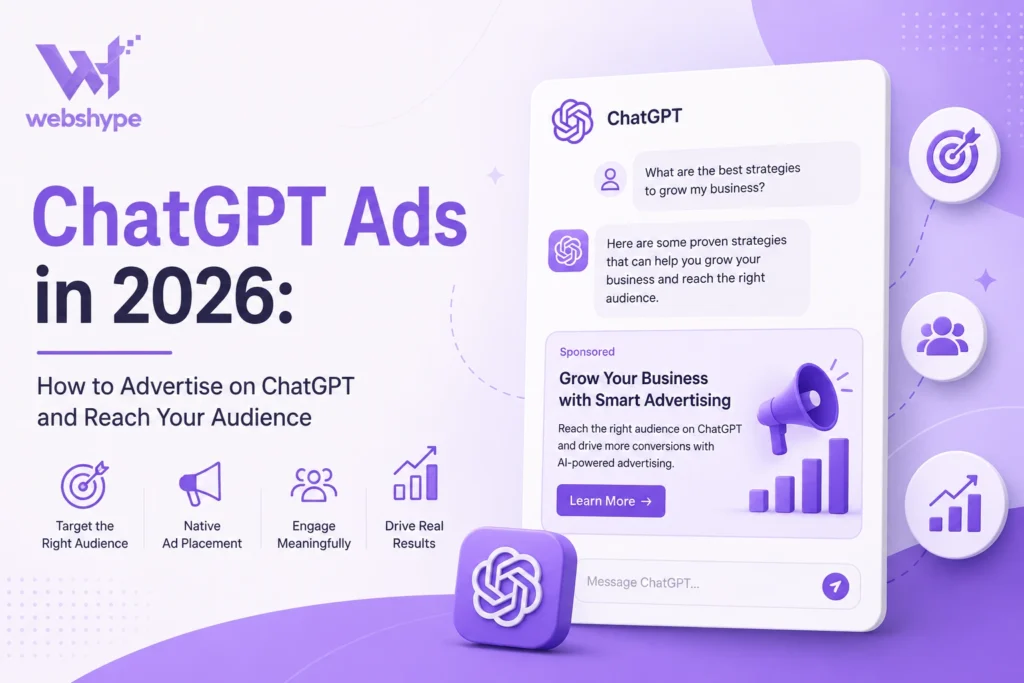
ChatGPT Ads are sponsored placements displayed within the ChatGPT experience, generally separated from the AI-generated response and clearly identified as Sponsored.
OpenAI has designed advertising so that paid placements do not influence the model’s organic response. In other words, an advertisement appears alongside the answer rather than changing what ChatGPT says.
Current advertising formats include:
- Sponsored placements: Brand name, headline, description, and a link to the advertiser’s website.
- Product-feed advertising: Eligible retail advertisers can use product catalogues containing information such as product names, images, and prices.
It’s also important to distinguish advertising from organic shopping results. When ChatGPT recommends products during a shopping conversation, those organic recommendations are not automatically paid advertisements. Sponsored product placements are separately identified as advertising.
How Do ChatGPT Ads Work?
ChatGPT advertising differs from traditional search advertising.
Google Ads, for example, can use keywords such as best running shoes to trigger an advertisement. ChatGPT Ads instead uses conversational signals to determine whether an advertisement is relevant to the current interaction.
The system can consider factors such as:
- The context and intent of the conversation
- Your advertisement’s copy and landing page
- Advertiser-provided context hints
- Relevant signals from a user’s broader ChatGPT experience where ad personalization applies
What Are Context Hints?
Context hints are natural-language descriptions that tell the advertising system what types of conversations or customer situations are relevant to your product.
For example, instead of entering:
running shoes, marathon shoes, running footwear
an advertiser might describe the situation as:
People preparing for their first marathon who are comparing comfortable running shoes for long-distance training.
This isn’t an exact-match keyword. Context hints help the system understand where your advertisement may be relevant, but they do not guarantee that your ad will appear in a particular conversation.
Who Sees ChatGPT Ads?
Ads may appear to logged-in users on the Free and Go plans.
Paid plans such as Plus, Pro, Business, Enterprise, and Edu do not see ads.
Advertising is also restricted in certain situations, including:
- Personal health and mental-health conversations
- Political content
- Accounts identified or predicted to belong to users under 18
Certain regulated industries may require additional review or approval. Categories such as political advertising are not permitted, while other restricted categories can face additional requirements.
For advertisers, this means the potential audience is substantial, but it is important to remember that the entire ChatGPT user base is not automatically an advertising audience.
Where Are ChatGPT Ads Available?
OpenAI’s self-service Ads Manager is currently available across a growing number of markets, including Australia and India, as well as countries across North America, Europe, Asia-Pacific, Latin America, and the Middle East and North Africa.
Because advertising availability is expanding, businesses should verify the current country availability inside OpenAI’s advertising documentation and Ads Manager before launching a campaign.
ChatGPT Ads in Australia
Australia is one of the established markets for ChatGPT advertising and is supported for self-service campaigns.
Can Australian Businesses Advertise on ChatGPT?
Yes. Australian businesses can create an eligible advertiser account and target Australian users through ChatGPT Ads.
Campaigns can use models such as:
- CPC
- CPM
- Conversion-optimized CPC
The minimum daily campaign budget is currently 25 AUD, although advertisers should confirm the current requirement before launching because pricing and minimums can change.
How Does Targeting Work in Australia?
Country-level targeting supports Australia. More granular location targeting is available in some markets, although the exact options depend on the country.
For Australia, advertisers should check the location selector inside Ads Manager rather than assuming that every city, region, or postal-code option available in the United States will also be available locally.
Can an Indian Business Target Australian Customers?
Yes, assuming both the advertiser account and selected target market are eligible.
Your business location and campaign target location are separate concepts.
For example:
| Campaign setting | Example |
|---|---|
| Business location | India |
| Target market | Australia |
| Website audience | Australian customers |
| Ad language | English |
| Currency in creative | AUD |
| Campaign targeting | Australia |
| Billing currency | Based on advertiser account |
| Australian business entity | Not automatically required |
The important point is accuracy. Your advertiser account should contain your real business and billing information. You should not represent an Indian business as an Australian business simply because the campaign targets Australia.
Therefore, an eligible Indian company can potentially run a campaign designed specifically for Australian customers without establishing an Australian business merely for advertising purposes.
How to Run Ads on ChatGPT
A practical launch process looks like this:
1. Research Your Audience
Start by understanding the questions your potential customers ask ChatGPT.
For example, an Australian customer might ask:
“What are the best accounting software options for a small business in Australia?”
Understanding these conversations helps you develop better creative and context hints.
2. Prepare Your Website
Make sure your landing page matches the promise made by your advertisement.
Your page should clearly communicate:
- What you offer
- Who it is for
- Pricing or relevant commercial information
- Key benefits
- A clear call to action
3. Create Your Advertiser Account
Register using your actual business information, including the relevant business, billing, currency, and location details.
4. Choose Your Campaign Model
Depending on your campaign objectives, you can choose between models such as CPM, CPC, and oCPC.
5. Write Context Hints
Describe the customer situation rather than creating a traditional keyword list.
Focus on:
Who is the customer? → What problem are they solving? → What are they considering? → Why is your product relevant?
6. Configure Targeting
Choose your geographic market and other available campaign controls.
You can also use eligible custom audiences for inclusion, exclusion, or bid adjustments.
7. Set Your Budget
Minimum budgets vary by currency. For example, the currently published minimum for Australia is 25 AUD per day.
Give a campaign enough budget and time to generate meaningful data rather than judging the channel after only a few clicks.
8. Add Conversion Tracking
Use the OpenAI Pixel, Conversions API, UTM parameters, or a combination of these tools.
9. Launch and Optimize
Monitor impressions, clicks, conversions, and cost. Compare ChatGPT Ads with your existing acquisition channels before increasing spend.
ChatGPT Ads Pricing
ChatGPT Ads does not operate on a simple fixed rate card. Advertising costs depend on the auction, competition, relevance, bidding strategy, and campaign conditions.
Available buying models include:
- CPM: Cost per thousand impressions
- CPC: Cost per click
- oCPC: Conversion-optimized CPC
The current minimum daily budget varies by billing currency. Examples include 25 AUD in Australia, 25 USD in the United States, and 725 INR in India.
Daily budgets should also be understood as an average spending target rather than necessarily an identical hard limit for every individual day.
There is no lifetime minimum commitment for self-service campaigns.
Advertisers should also be cautious about claims regarding an “average CPC.” Reported starting bids may provide a rough benchmark, but actual costs can vary considerably by industry, competition, audience, and campaign relevance.
ChatGPT Ads Targeting Options
One of the biggest differences between ChatGPT Ads and traditional advertising platforms is how targeting works.
Context Hints
Natural-language descriptions help communicate the conversations where your product is relevant.
Geographic Targeting
Country-level targeting is available in supported advertising markets. More granular options may be available depending on the market.
Platform Targeting
Campaigns can potentially be configured for:
- Web
- iOS
- Android
Custom Audiences
Custom audiences provide another important targeting option.
Advertisers can upload audience data using identifiers including:
- Email addresses
- Phone numbers
- SHA-256 hashed email addresses
- SHA-256 hashed phone numbers
- Google Advertising IDs (GAIDs)
Custom audiences can be used for inclusion, exclusion, or bid adjustments.
Inclusion targeting and audience bid adjustments require at least 25,000 matched users, with OpenAI recommending 100,000 or more for those applications.
Smaller audiences, including empty audiences, can still be used for exclusion-only targeting.
When inclusion and exclusion are combined, the remaining eligible audience must still satisfy the applicable 25,000-user minimum.
Importantly, advertisers do not receive a list of individual matched ChatGPT users or access to their conversations.
What Isn’t Available?
Compared with Google and Meta, self-service ChatGPT Ads currently have fewer traditional targeting controls. These include:
- Age targeting
- Gender targeting
- Income targeting
- Lookalike audiences
- Device-level targeting
This makes conversational relevance much more important to campaign strategy.
Measuring ChatGPT Ad Performance
Advertisers can use several measurement methods.
OpenAI Pixel
The Pixel can track actions occurring on your website after users interact with your advertisement.
Conversions API
The Conversions API allows businesses to send conversion events server-side, which can complement browser-based tracking.
UTM Parameters
UTM and other static tracking parameters can be added to landing-page URLs. This allows existing analytics platforms to identify traffic generated by ChatGPT Ads.
For many businesses, implementing UTM tracking from the beginning is a simple first step, even if a more advanced Pixel or Conversions API setup is added later.
Reporting is generally aggregated rather than exposing individual user-level information.
ChatGPT Ads vs Google and Meta
| Feature | ChatGPT Ads | Google / Meta |
|---|---|---|
| Core targeting | Conversational context | Keywords and/or audience segments |
| Context hints | Yes | No equivalent |
| Demographic targeting | Limited | Extensive |
| Geo targeting | Available, varies by market | Highly developed |
| Custom audiences | Available | Available |
| Lifetime minimum | None for self-service | Varies |
| Conversion tracking | Pixel, API, UTMs | Mature tracking ecosystems |
| Organic relationship | AEO + paid | SEO + paid |
The biggest difference is simple: ChatGPT Ads are built around conversational intent rather than traditional keyword targeting.
Best Practices for ChatGPT Ads
Write Context Hints Like a Customer Brief
Don’t think like a keyword advertiser. Describe the person, situation, problem, and buying intent.
Match Your Landing Page
Your context hint, advertisement, and landing page should tell a consistent story.
Start With a Controlled Test
Don’t immediately move a large advertising budget to a new channel. Test the campaign, collect conversion data, and compare results with other channels.
Don’t Copy Your Google Ads Strategy
A list of hundreds of keywords and negative keywords isn’t the natural starting point for ChatGPT advertising.
Think instead about questions, problems, comparisons, and customer situations.
Combine Paid and Organic Visibility
Paid advertising and AEO can complement each other. Understanding how your brand appears in ChatGPT’s organic responses can help you create advertising that feels relevant and consistent.
Frequently Asked Questions
Yes. Eligible businesses can use OpenAI’s self-service Ads Manager and other supported advertising partners.
Yes. Australia is a supported advertising market.
Yes, provided the advertiser and campaign are eligible. Your business location does not have to be the same as your campaign’s target market.
There is no fixed universal CPC. Campaign costs depend on the auction and campaign conditions. Minimum daily budgets vary by billing currency.
Ads may appear to logged-in Free and Go users. Paid plans such as Plus, Pro, Business, Enterprise, and Edu do not see ads.
Yes. Eligible custom audiences can be created using supported identifiers such as email, phone, hashed identifiers, and GAIDs, subject to audience-size requirements.
Conclusion
ChatGPT Ads offer a new approach to digital advertising based on conversational intent and relevance rather than traditional keywords.
For Australian businesses and companies targeting Australia, ChatGPT Ads can help reach customers while they research and compare solutions.
Start with a focused test, strong context hints, a relevant landing page, and proper conversion tracking. If you’re considering ChatGPT Ads for your business, get in touch with Webshype to discuss your digital strategy.
